Interactive — Mobile guide
Bauhaus Walk
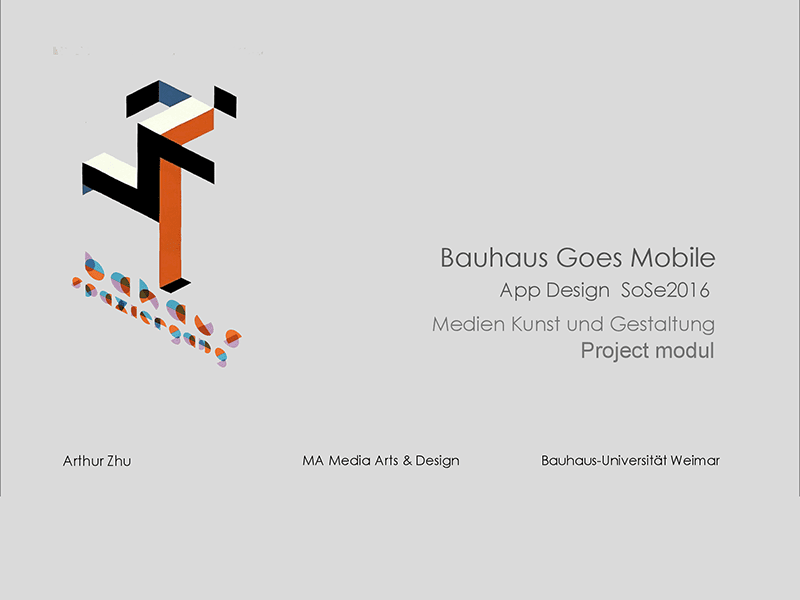
The Bauhaus Walking Tour is an integral part of Weimar’s cultural landscape: guides show visitors what it means to study, learn and live at this unique university. During my master’s at Bauhaus-Universität Weimar I helped design an immersive companion experience.
The problem
How do you let visitors experience Weimar’s Bauhaus heritage — past and present — beyond the fixed schedule of a guided tour?
My role
Concept and design during my master’s: ideation, prototyping, technical research and user testing for an immersive walking-tour companion.
Core decision
Success is measured by how little the interface is used. Every second on the screen is a second not spent looking at the building.
The outcome
Many of our core features were incorporated into the officially released app.
01 ChallengeHeritage is available continuously; access to interpretation is not. The centenary made that gap acute.
The Bauhaus was founded in Weimar in 1919. The Bauhaus Walking Tour is a fixture of the city's cultural life — student guides walk visitors through the sites where the school began and show what it means to study and live at the university that succeeded it. The tour is not a museum experience; it is people showing other people around a place they actually inhabit.
We worked on a companion experience for it during my master's at Bauhaus-Universität Weimar, in the run-up to the centenary — a year when the city expected significantly more visitors than its guided tour capacity could absorb.
That framed the problem. A guided tour is limited by scheduling and by the number of guides available. The heritage is available continuously; access to interpretation is not. The question was how to let visitors experience Weimar's Bauhaus history — past and present — outside the fixed schedule, without producing a thin substitute that competes with the thing that makes the tour good.
02 The design constraintsThe interface competes with the thing it is about — and the environment is uncontrolled.
The interface competes with the thing it is about
This is the defining constraint of heritage applications and the one most of them fail. The purpose is to make someone look at a building, a street, a place. Every second spent reading a screen is a second spent not doing that. Success is measured in how little the interface is used, which inverts almost every engagement metric a product designer normally optimises toward.
The environment is uncontrolled
Outdoor use means sunlight on a screen, gloves in winter, one hand occupied, ambient noise, and GPS that behaves unreliably between buildings in a dense historic centre. None of these can be designed away; they have to be designed around.
Pace is set by the visitor, not the product
People walk at different speeds, stop where they find something interesting, double back, and take breaks. A linear experience that assumes a fixed sequence and duration breaks the moment someone deviates — and deviating is the normal behaviour of a person exploring a city.
Past and present are both the subject
The brief was not only historical. The tour shows what the Bauhaus was and what studying at the university is now. That dual subject shaped what the companion had to carry: not just archival interpretation of 1919, but the living institution occupying those buildings today.
03 My roleConcept and design within a student team, prototyped on the actual route rather than at a desk.
- Concept ideation for the companion experience and its relationship to the guided tour.
- Interface and experience design for use while walking.
- Prototyping to test concepts in the actual environment rather than at a desk.
- Technical research into what was feasible for location-based delivery on site.
- User testing with visitors and students.
- How many people were on the team, and what did you own versus contribute to?
- How did you test — did you take prototypes out onto the route? What happened?
- What did testing change about the concept?
- Which specific features were incorporated into the officially released app? Name them. That is the strongest fact on this page and it is currently unspecified.
04 OutcomesCore features incorporated into the officially released app.
Product
Many of our core features were incorporated into the officially released Bauhaus Walk app — an unusual outcome for academic work, and the clearest evidence that the concept held up outside the studio.
What it taught me
Designing for a physical environment removes the assumption that the screen has the user's attention. That constraint has stayed useful in every product I have worked on since — including in-store scanning at Penny, where the same conditions apply, and in any flow where the interface is not the reason the person is there.
-(1)-copy-001.jpg)
-(1)-copy-002.jpg)
-(1)-copy-003.jpg)
-(1)-copy-004.jpg)
-(1)-copy-005.jpg)
-(1)-copy-006.jpg)
-(1)-copy-007.jpg)
-(1)-copy-008.jpg)
-(1)-copy-009.jpg)
-(1)-copy-010.jpg)
-(1)-copy-011.jpg)
-(1)-copy-012.jpg)
-(1)-copy-013.jpg)
-(1)-copy-014.jpg)
-(1)-copy-015.jpg)
-(1)-copy-016.jpg)
-(1)-copy-017.jpg)
-(1)-copy-018.jpg)
-(1)-copy-019.jpg)
-(1)-copy-020.jpg)
-(1)-copy-021.jpg)
-(1)-copy-022.jpg)
-(1)-copy-023.jpg)
-(1)-copy-024.jpg)
-(1)-copy-025.jpg)
-(1)-copy-026.jpg)
-(1)-copy-027.jpg)
-(1)-copy-028.jpg)
-(1)-copy-029.jpg)
-(1)-copy-030.jpg)
-(1)-copy-031.jpg)
-(1)-copy-032.jpg)
-(1)-copy-033.jpg)
-(1)-copy-034.jpg)
-(1)-copy-035.jpg)
-(1)-copy-036.jpg)
-(1)-copy-037.jpg)
-(1)-copy-038.jpg)
-(1)-copy-039.jpg)
-(1)-copy-040.jpg)
-(1)-copy-041.jpg)
-(1)-copy-042.jpg)
-(1)-copy-043.jpg)
-(1)-copy-044.jpg)
-(1)-copy-045.jpg)
-(1)-copy-046.jpg)
-(1)-copy-047.jpg)
-(1)-copy-048.jpg)
-(1)-copy-049.jpg)
-(1)-copy-050.jpg)
-(1)-copy-051.jpg)